3 Critical Mistakes in Project Planning (And How to Fix Them)
Introduction
As a project manager and strategic advisor working in pharma and biotech, I've witnessed countless projects struggle—not because of poor execution, but because of fundamental flaws in how they're financially modeled and planned. In sectors where projects often sit outside the commercial side of business and lack clear revenue connections, the traditional financial modeling playbook simply doesn't work.
The reality is that projects in these industries are frequently poorly defined, driven by impact objectives rather than bottom-line metrics. This creates unique challenges that require a different approach to financial planning and project justification. Through years of working with clients in higher education, pharma, and biotech, I've identified three critical mistakes that organizations repeatedly make—and more importantly, how to fix them.
Mistake #1: Failing to Clearly Define the Problem
The first and perhaps most significant mistake I see is the failure to articulate the problem being solved with sufficient clarity. Too often, project teams jump straight into solutions without establishing a compelling narrative around what's at stake.
Why This Matters
When you can't clearly define the problem, you can't build a convincing case for your project. Leadership needs to understand what's possible without the project, what's not possible without it, and what could become profitable if it's delivered successfully.
The Solution
Start by answering these fundamental questions:
What capabilities or outcomes are currently impossible without this project?
What inefficiencies, risks, or missed opportunities exist in the current state?
If this project succeeds, what tangible benefits or profitability could result?
Can any of these impacts be quantified, even roughly?
Quantification is key here. Even if your project isn't directly tied to revenue, there are usually ways to measure impact—whether that's time saved, risks mitigated, capacity increased, or quality improved. These quantified impacts become the foundation of your project narrative and business case.
Mistake #2: Developing Weak or Non-Existent Business Cases
The second major mistake is either skipping the business case entirely or creating one that's too vague to be useful. Many organizations in the pharma and biotech space aren't accustomed to formal business cases, especially for non-commercial projects. But even if formal documentation isn't your organizational norm, the underlying thought process is still essential.
What a Strong Business Case Includes
Your business case doesn't need to be a 50-page document, but it should clearly communicate:
The problem being solved: Drawing from the work you did in step one
Why this approach: Your rationale for choosing this particular solution over alternatives
Expected results: What you'll achieve and how you'll measure success
Impact quantification: Cost savings, efficiency gains, risk reduction, or capability improvements
Resource requirements: What you need to make it happen
The business case is fundamentally about storytelling. You're crafting a narrative that helps leadership understand the value proposition and make informed decisions about resource allocation.
Communicating Your Business Case
Don't let your business case gather dust in a SharePoint folder. This narrative needs to be actively communicated to leadership through presentations, updates, and ongoing conversations. The clearer and more compelling your business case, the easier it becomes to secure buy-in and resources.
Mistake #3: Poor Vendor-Scope Alignment
The third critical mistake I see is a disconnect between what organizations need and what vendors propose. This misalignment often stems from vendors' strong sales tactics combined with organizations' lack of clarity about their actual requirements.
The Problem
Here's how it typically unfolds: An organization has a vague sense that they need something. A vendor comes in with an impressive presentation about their solution. The vendor's sales team is skilled and persuasive. Before you know it, the organization has committed to implementing something that may not actually align with their project objectives or scope requirements.
I've seen this pattern repeat itself across multiple organizations. The resulting projects often fail to deliver the expected impact because the purchased solution was never properly aligned with the actual need.
How to Achieve Better Alignment
To avoid this trap, be explicit and detailed when engaging with vendors:
Document your objectives: Before talking to any vendor, write down exactly what you're trying to accomplish
Define required scope: Be specific about what capabilities, features, or deliverables you need
Clarify intended impact: Explain the outcomes you expect to achieve
Request aligned proposals: Ask vendors to specifically address how their solution meets your documented needs
Incorporate into your business case: The vendor scope and cost should directly support the narrative you've built
Don't let vendor sales tactics drive your decision-making. Instead, use your clearly defined problem statement and business case as a filter for evaluating whether a vendor's offering truly meets your needs.
Bonus Strategy: Embrace Scenario Planning
While not strictly a "mistake," many organizations underutilize scenario planning as a tool for managing uncertainty in project planning. This is especially valuable in pharma and biotech, where projects often involve inherent ambiguity.
Why Scenario Planning Works
Scenario planning helps you address uncertainty head-on by developing multiple versions of your project plan based on different assumptions or constraints. This approach is particularly valuable for teams that are uncomfortable with ambiguity—it gives them a structured way to think through possibilities rather than freezing in the face of unknowns.
How to Implement Scenario Planning
Develop at least two scenarios for your project:
Maximum scope scenario: What can be achieved if you have optimal resources, timeline, and conditions?
Minimum viable scope scenario: What's the smallest scope that would still deliver material impact?
You might also develop a "most likely" middle scenario. For each scenario, clarify the scope, resource requirements, timeline, and expected impact. This gives leadership options and helps them understand the trade-offs of different investment levels.
Scenario planning also provides flexibility as your project evolves. If constraints change or new information emerges, you already have alternative pathways mapped out rather than scrambling to adjust on the fly.
Putting It All Together
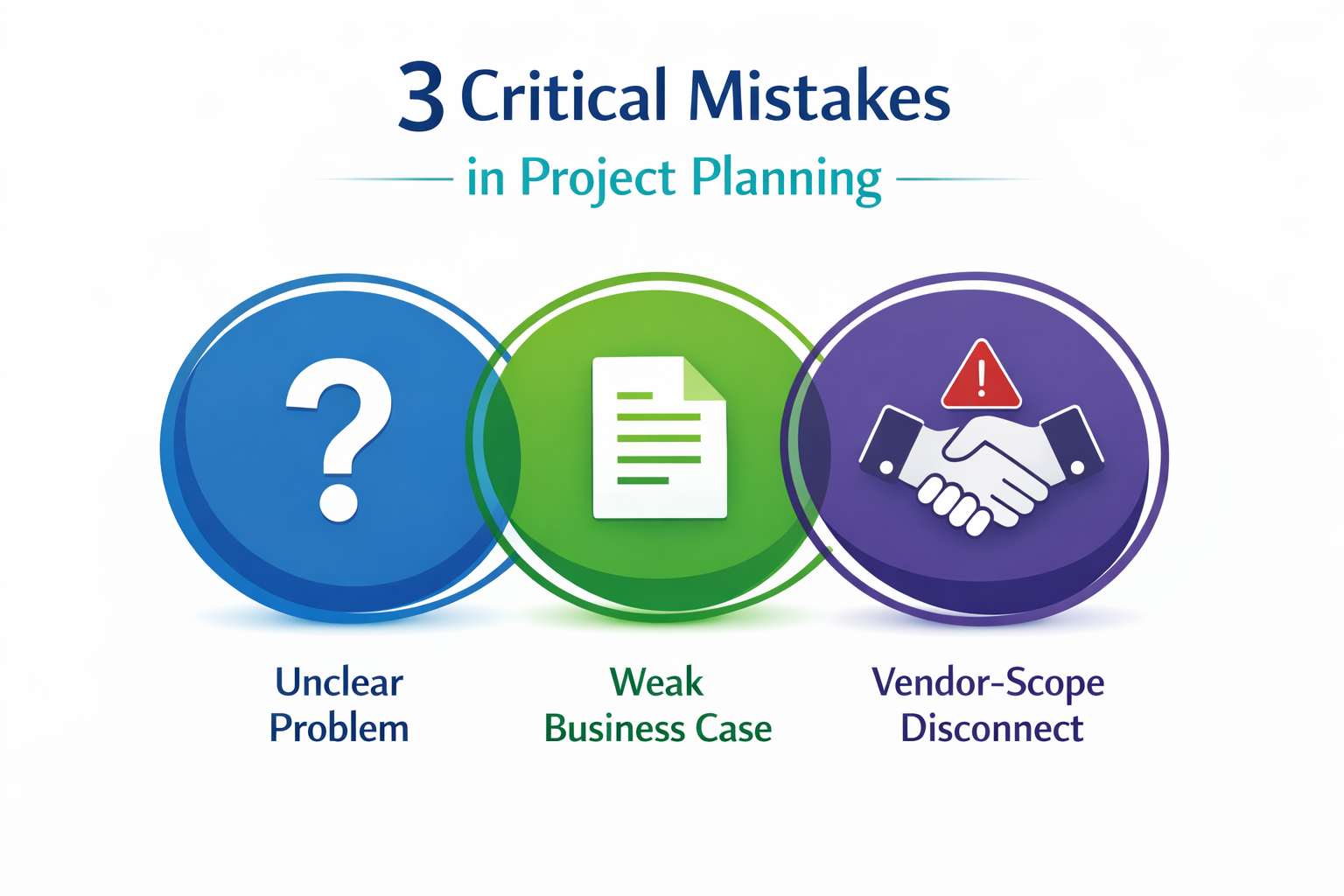
These three mistakes—unclear problem definition, weak business cases, and poor vendor-scope alignment—are interconnected. Fixing one makes it easier to address the others:
A clearly defined problem naturally leads to a stronger business case
A strong business case makes it easier to evaluate vendor proposals
Good vendor-scope alignment ensures your project can actually deliver the impact described in your business case
Add scenario planning to the mix, and you have a robust framework for planning projects in environments characterized by uncertainty and ambiguity.
Conclusion
Financial modeling and project planning in pharma and biotech require a different approach than in more commercially-oriented sectors. Projects that aren't directly tied to revenue or that focus on generating impact need special attention to how they're defined, justified, and scoped.
By avoiding these three critical mistakes—and embracing scenario planning as a tool for managing uncertainty—you can dramatically improve your project success rate. Your projects will have stronger justification, clearer scope, and better alignment between what you need and what you're actually implementing.
The key is to start with clarity: be clear about the problem, clear about the business case, clear about what you need from vendors, and clear about the scenarios under which your project can succeed. This clarity becomes your north star throughout the project lifecycle, helping you make better decisions and communicate more effectively with stakeholders.
What financial modeling challenges have you encountered in your project planning? I'd love to hear about your experiences and what strategies have worked for you.